28 October 2026 · Orbit Multiprint
Restaurant menu formats: laminated card, folder, booklet or table tent?
Which menu format fits your service style, what each is made of, and how to keep price changes from becoming reprints.
A menu is the only piece of printing a restaurant hands to every customer, and the one that gets replaced most often, because prices change. The format you choose decides how the menu feels, how long it lasts and how much a price change costs you. Here are the formats we print, what they are made of, and how to pick one for your service style.
The formats
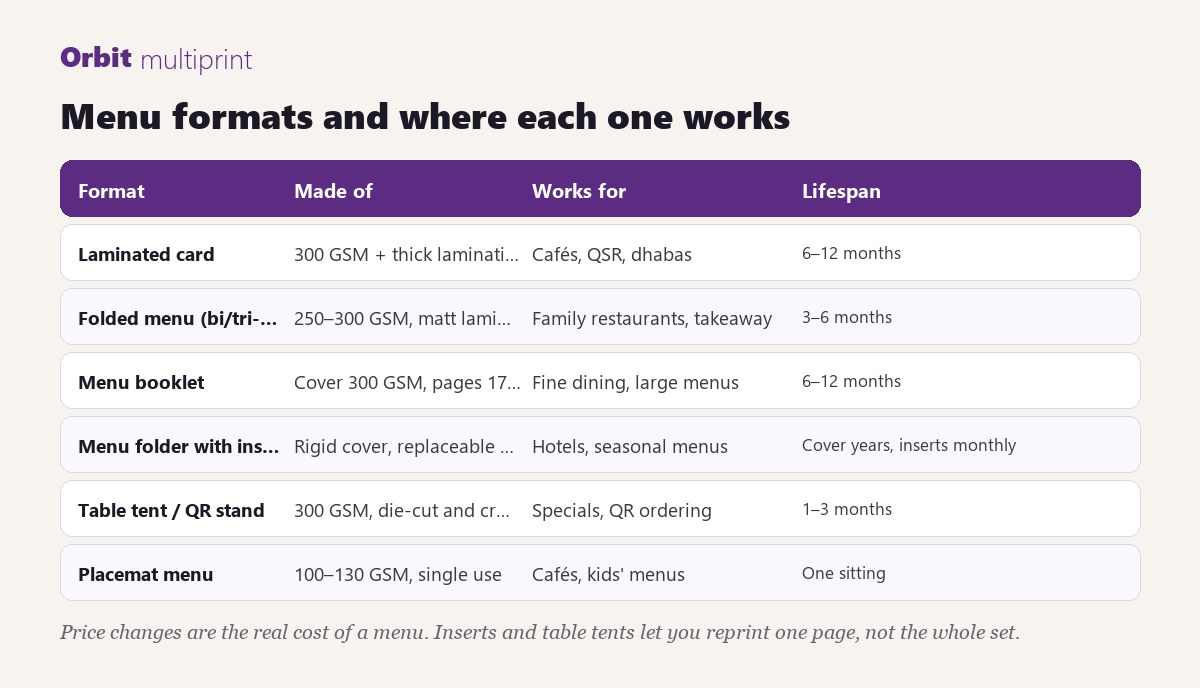
Laminated card. A single sheet, usually A4 or a long 4 × 11 inch, printed both sides on 300 GSM and sealed in thick lamination. Wipes clean, survives spills, stacks at the counter. Cafés, quick-service restaurants, dhabas and takeaways. Lasts six to twelve months.
Folded menu. A bi-fold or tri-fold on 250 to 300 GSM with matt lamination. More space than a card, still handheld. Family restaurants and takeaway menus that go home with the customer.
Menu booklet. A 300 GSM laminated cover with 170 GSM inside pages, stitched or wiro-bound. For long menus and fine dining, where the menu is read slowly. Photos belong here.
Menu folder with inserts. A rigid printed cover that holds replaceable inner pages. The cover lasts years; the inserts are reprinted when prices change. Hotels, restaurants with seasonal menus, bars with rotating specials.
Table tent and QR stand. A die-cut, creased card that stands on the table. Specials, desserts, drinks, or a QR code for digital ordering. Short-lived by design, cheap to refresh.
Placemat menu. 100 to 130 GSM paper, single use, doubles as the placemat. Cafés and kids' menus.
Matching the format to the service
- Order at the counter, eat fast: laminated card or a board behind the counter plus a takeaway folded menu.
- Table service, quick turnover: laminated card or folded menu, one per cover.
- Table service, relaxed: booklet or folder with inserts, half as many as covers plus spares.
- Bar or café with weekly specials: folder plus table tents.
- Delivery-heavy: a folded menu that goes in every bag, printed in larger quantities on lighter paper.
The real cost is the reprint
A menu printed once is cheap. A menu reprinted every time the gas cylinder goes up is not. Two formats protect you: the folder with inserts, where only the changed page is reprinted, and the table tent, which carries the specials so the main menu changes less often. We keep your artwork on file, so a price change is a one-page edit and a small reprint, not a new design job.
Design notes that sell food
1. Photograph your own food in daylight. Stock photos of someone else's biryani cost you trust. 2. Group dishes the way people order: starters, mains, breads, rice, desserts, drinks. Keep each group short. 3. Put the dishes you want to sell in the top right of each spread and give them a line of description. 4. Prices in a clean column, no leader dots; leader dots make customers scan for the cheapest. 5. Two typefaces, maximum. One size for dish names, one for descriptions. 6. Allergen and veg/non-veg marks where the law and your guests expect them.
From a Word file to the table
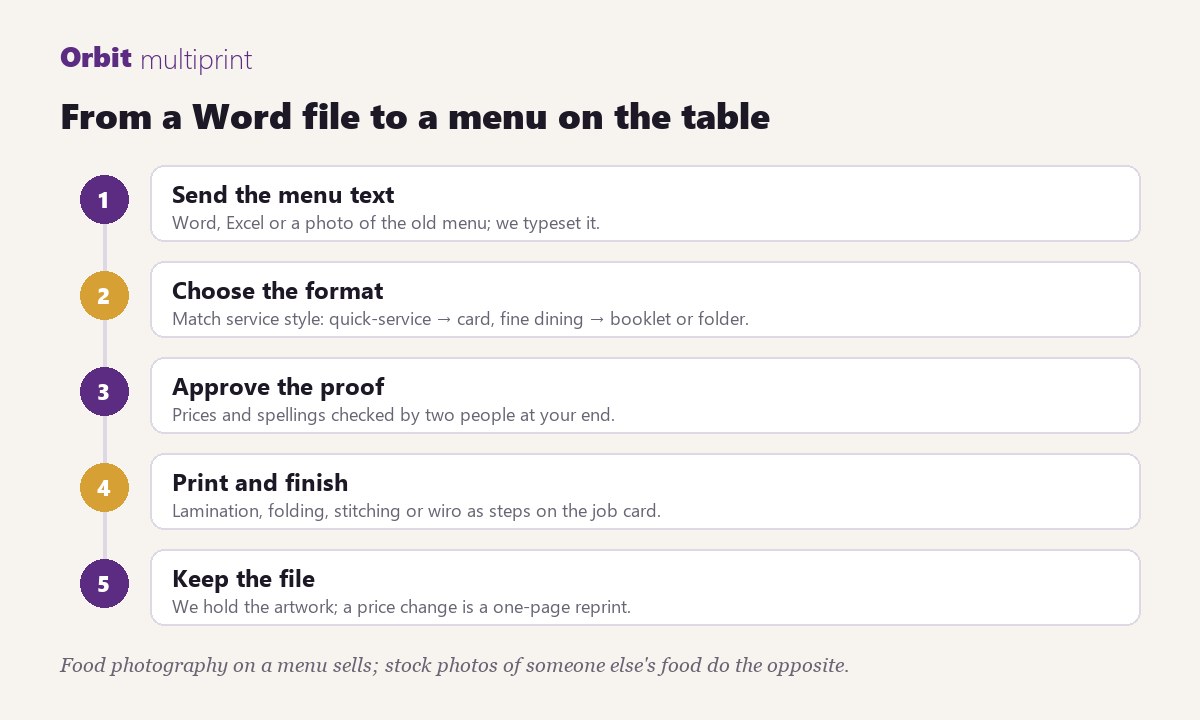
Send the menu as text or a photo of the old one, pick the format, and we typeset and proof it. Ask two people at your end to check prices and spellings on the proof; it is the single step that prevents the costly reprint. Printing, lamination, creasing, stitching or wiro, and packing are each steps on the job card.
See restaurant menu printing for the full options or send your menu to WhatsApp +91 90165 28799. Our earlier post on menu printing prices explains how quantity and format move the price.