28 October 2026 · Orbit Multiprint
Patient file printing for hospitals and clinics: board, sizes and layout
What a durable case file is made of, how to lay out the fields, and how to order and reorder so the record room stays uniform.
A patient file is opened, written in, carried between wards and stacked for a year or more. It is also the first printed thing a patient's family sees with the hospital's name on it. It needs to be strong enough for daily handling, laid out so staff find the fields without thinking, and printed consistently across reorders so the record room stays uniform. Here is how we make them.
What a patient file is made of
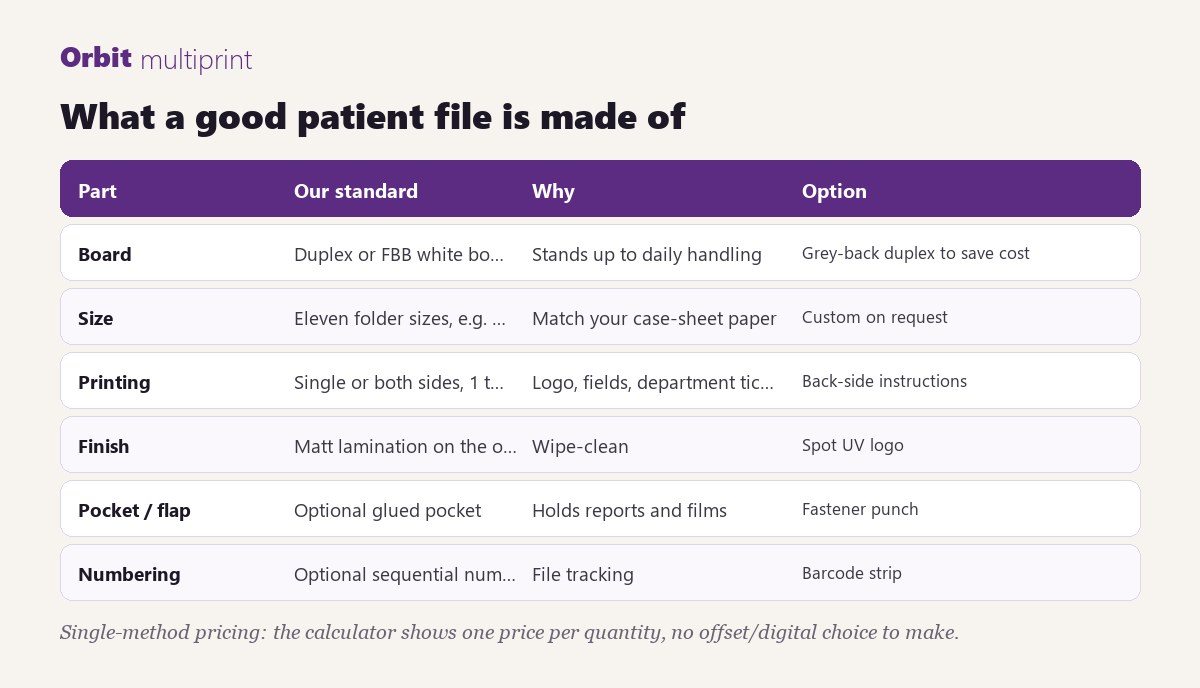
Board. Duplex or FBB white board between 250 and 350 GSM. Lighter board folds at the spine within weeks; heavier board survives the year. Grey-back duplex keeps the cost down where the inside is plain; white board gives a cleaner inside for printed fields.
Size. Files are sized to the case sheets they hold. Our calculator offers eleven standard folder sizes, from compact OPD folders to large open-flat case files such as 9.5 × 13.5 inches closed. Send us a used file and we match it; custom sizes are possible for larger runs.
Printing. Single or both sides, one to four colours. Front: hospital identity, department, patient fields. Back: instructions, emergency numbers, visiting hours, consent notes. Printing on the inside adds fields where the staff actually write.
Finish. Matt lamination on the outside wipes clean and resists the grey that paper picks up from handling. A spot UV logo is an inexpensive lift for private hospitals and clinics.
Pocket, flap and fastener. A glued pocket holds reports and films; a punched fastener holds loose sheets; a flap keeps everything in when the file is carried.
Numbering and barcodes. Sequential numbers or a barcode strip for record tracking can be printed on each file.
Designing the fields
The field layout decides whether staff use the file properly. Rules that work:
- Patient name, UHID or registration number, age, sex and department on the front, in large type, in the top third.
- Tick boxes for departments and wards rather than blank lines; ticks are faster and legible.
- Consultant name and admission date on the front; discharge fields on the back.
- Leave real writing space: a 6 mm line height minimum.
- One colour for the fields and the hospital colour for the identity. Two colours are easier to read than four.
Many hospitals use one file for OPD and IPD with a tick to mark which; larger hospitals use a colour-coded set per department so a file is recognisable across the corridor.
Ordering, step by step
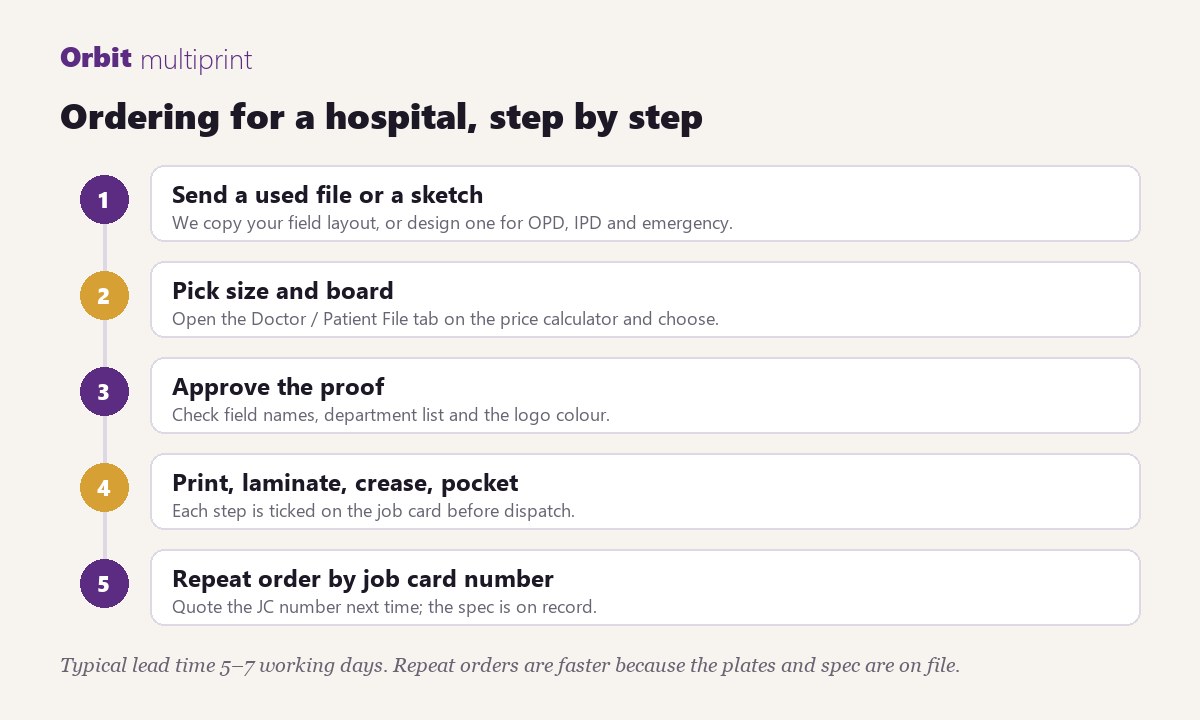
Open the Doctor / Patient File tab in our price calculator, choose the size, board and quantity, and you get a single price per quantity; files are a single-method job, so there is no offset-or-digital choice to make. Send a used file or a sketch and we lay out the fields, then send a proof for the administration and the records team to check. Printing, lamination, creasing and pocket pasting are steps on the job card, ticked before dispatch.
Reorders
The job card number is the key to a repeat order. Quote it, and the size, board, colours and artwork come off the record; nothing needs to be re-sent and the new batch matches the old one on the shelf. Typical lead time is five to seven working days; repeats are faster.
Other hospital stationery
Prescription pads, OPD slips, consent forms, lab report covers, appointment cards and department signage are usually ordered with the files so the identity is consistent. See office stationery and the estimate and pad printing page for pads.
View the doctor and patient file product, or send a photo of your current file to WhatsApp +91 90165 28799 and we will come back with a layout and a price for your quantity.