28 October 2026 · Orbit Multiprint
Box styles explained: mailer, tuck-end, rigid and die-cut
Which box style suits your product, the board behind each one, and how a custom box goes from a measurement to a printed carton.
The first packaging question is never "what design?" It is "which box?" The style of box decides the board, the printing process, the minimum quantity and how the box ships to you. Choose the style first and the rest follows. Here are the styles we make most, what each suits, and how a custom box goes from a measurement to a printed carton.
The styles
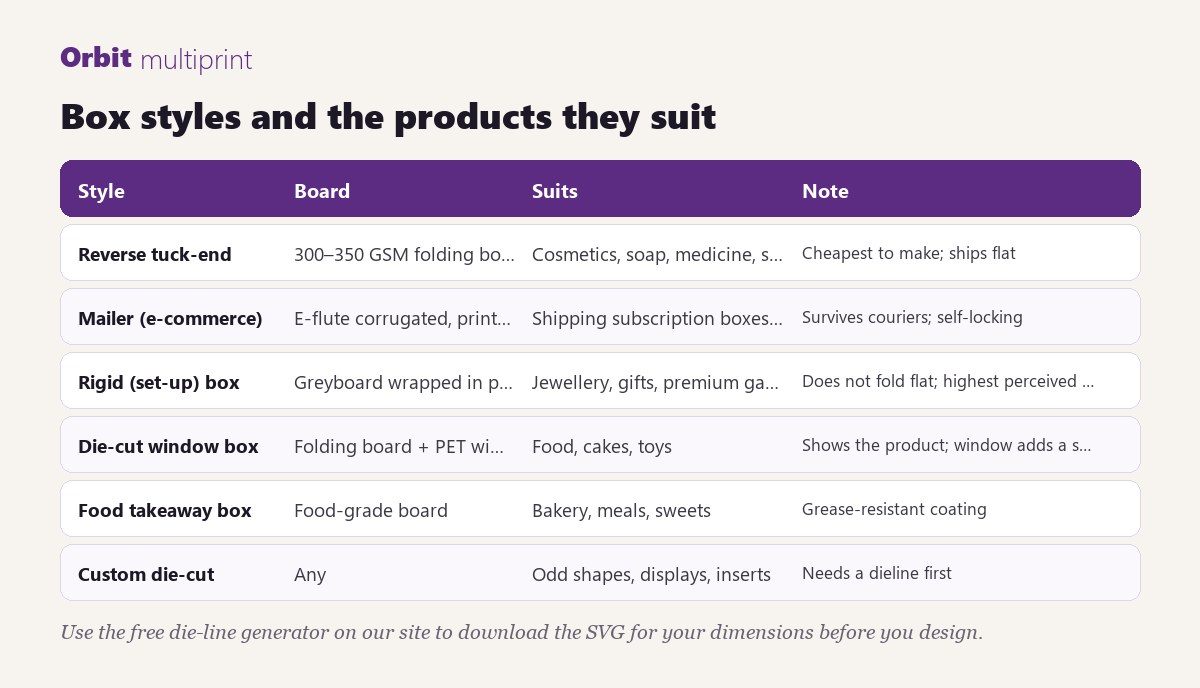
Reverse tuck-end (RTE) and straight tuck-end. The everyday folding carton: four panels, a tuck flap at each end, glued along one seam. Made from 300 to 350 GSM folding board, printed offset or digital, laminated or varnished. Cosmetics, soap, medicine, small electronics, tea. It ships flat and is the cheapest printed box to make. See our cosmetic box, soap box and medicine box.
Mailer box. The e-commerce box with the self-locking lid and side flaps. Made from E-flute corrugated with a printed outer liner, so it survives couriers without an outer carton. Subscription boxes, apparel, gift kits. See the mailer box and our earlier guide on designing mailer boxes that survive shipping.
Rigid (set-up) box. Thick greyboard wrapped in printed paper, assembled by hand, does not fold flat. The box jewellery, premium gadgets and gift sets arrive in. Highest perceived value, highest cost, and a higher minimum because every box is built individually. See gift rigid box and jewellery box.
Window box. A folding carton with a die-cut opening, usually fitted with a clear PET sheet. Cakes, toys, food, anything the buyer wants to see. See the cake and bakery box.
Food takeaway box. Food-grade board with a grease-resistant coating, folded without glue where possible. See the food takeaway box.
Custom die-cut. Anything else: display boxes, inserts, odd shapes, hangers. These start from a dieline.
Board: the part nobody sees but everyone feels
- Folding box board (FBB), 300–350 GSM: white both sides, smooth print surface. Cosmetics, pharma, premium retail.
- Duplex board, grey back, 250–350 GSM: white print side, grey inside. Economical cartons where the inside is not seen.
- E-flute corrugated: a thin fluted layer between liners. Strength for shipping with a printable face.
- Kraft: brown, unbleached. Natural and sustainable look; print in one or two colours.
From measurement to shelf
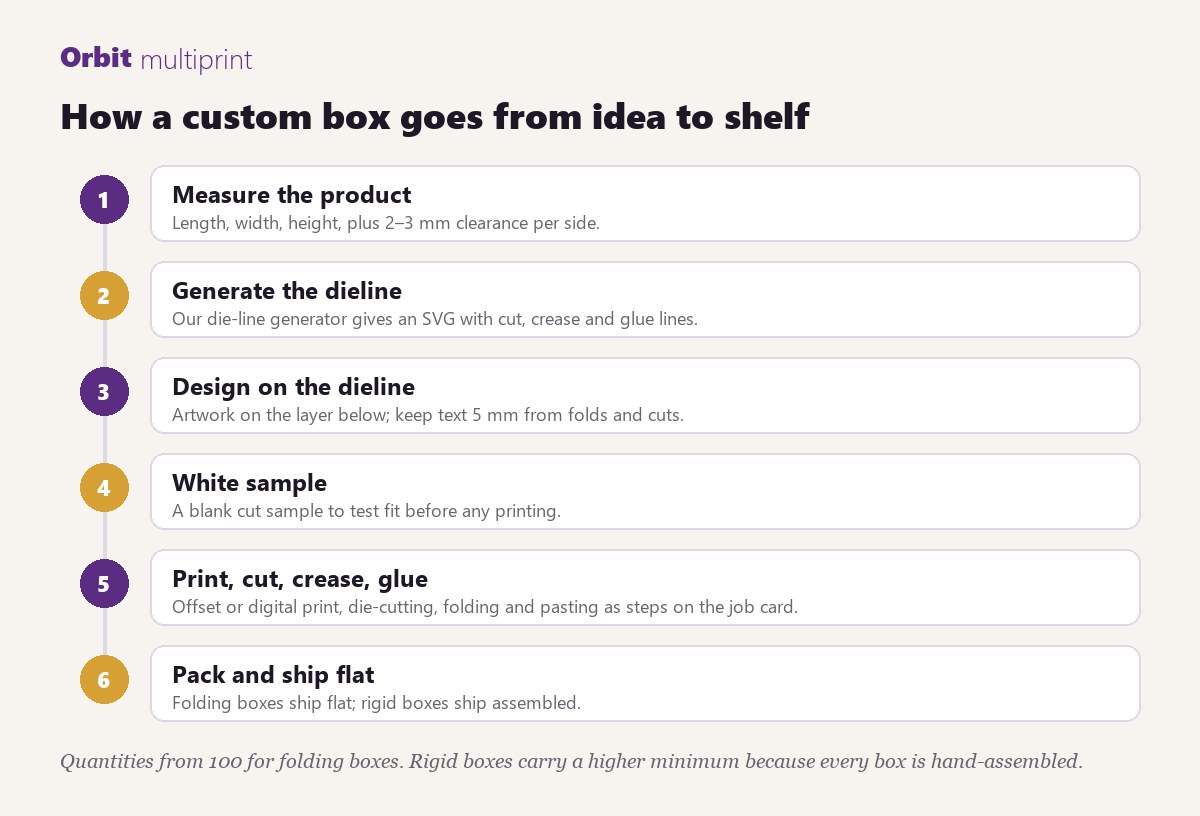
Measure the product, then add 2 to 3 mm of clearance per side so it slides in without forcing.
Generate the dieline. Our free die-line generator draws the flat template for tuck-end boxes, bags and cartons from your dimensions and gives you an SVG with cut, crease and glue lines, plus a price for your quantity and board.
Design on the dieline. Keep the dieline on its own layer and never move it. Keep text 5 mm away from folds and cuts, because artwork that crosses a crease looks broken.
White sample. Before any printing we can cut a blank sample so you can test the fit. This is the cheapest mistake you will ever avoid.
Print, cut, crease, glue. Each stage is a step on the job card: printing, lamination or varnish, die-cutting, stripping, folding and gluing, packing. The card is ticked step by step before dispatch.
Ship flat. Folding cartons and mailers arrive flat in bundles and pop up in seconds. Rigid boxes arrive assembled.
Quantities and lead time
Folding boxes start from 100 pieces for digital print and become much more economical from 1,000 on offset. Mailers follow the same pattern. Rigid boxes carry a higher minimum because of the hand assembly. Allow seven to ten working days after proof approval for folding boxes and longer for rigid.
Questions to answer before you enquire
1. What goes inside, and its exact dimensions? 2. Will the box ship on its own or inside a carton? 3. Does the buyer need to see the product? 4. One design or several sizes? 5. Quantity for the first run and for a repeat?
Send those answers and a photo of the product to WhatsApp +91 90165 28799, or start from the packaging range and the die-line generator. We will recommend the style, the board and the quantity break that makes sense.