28 October 2026 · Orbit Multiprint
Offset vs digital printing: which is right for your quantity?
How each process works, where the break-even falls for flyers, brochures, letterheads and catalogues, and when the cheaper press is still the wrong choice.
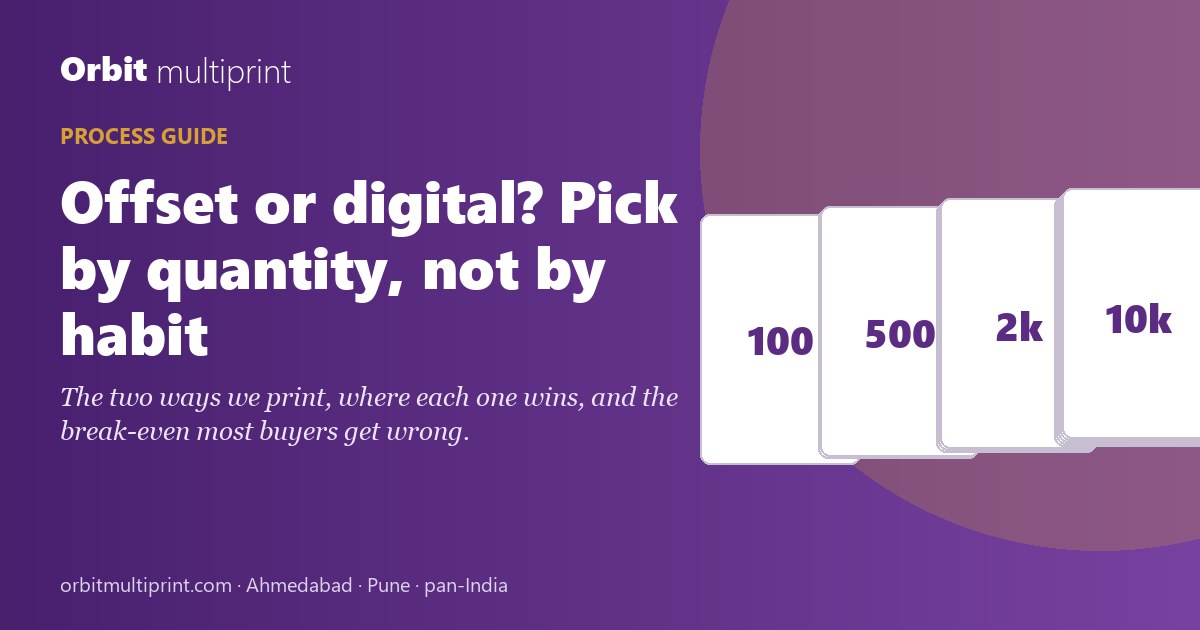
"Offset or digital?" is the first question we answer on most jobs, and the honest answer is: it depends on your quantity, your deadline and your colours. Neither is better. One of them is cheaper and more suitable for your job, and the only way to know is to price both. This guide explains how each process works, where the break-even usually falls, and the cases where the cheaper option is still the wrong one.
How the two processes work
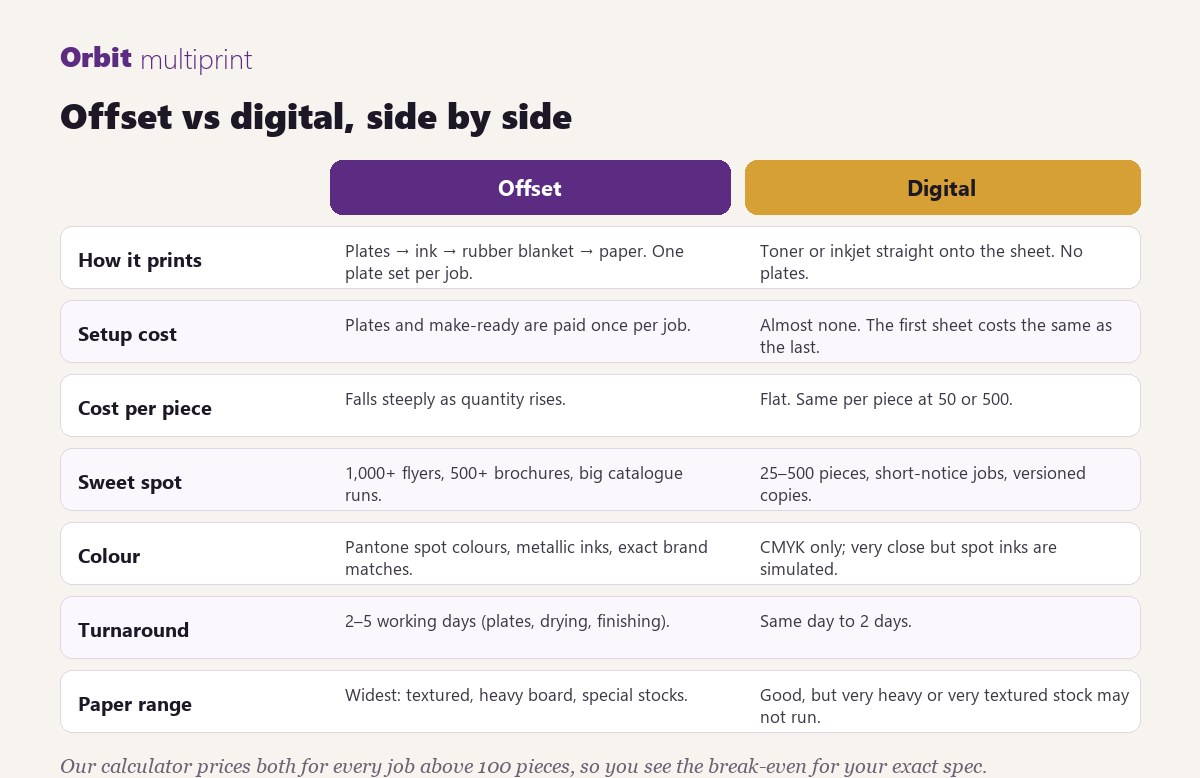
Offset printing transfers ink from a metal plate to a rubber blanket to the paper. Every job needs its own plates (one per colour), and the press needs make-ready sheets to settle colour and register. That setup is paid once, whether you print 500 sheets or 50,000. After that, each extra sheet costs very little: paper plus a few paise of ink.
Digital printing puts toner or ink directly on the sheet. There are no plates and no make-ready, so the first sheet costs the same as the thousandth. It is fast and flexible, but the cost per sheet never falls the way offset's does.
The break-even is lower than most people think
Buyers often assume offset only makes sense at 5,000 or 10,000 pieces. For a lot of everyday jobs the line is much lower:
- A5 flyers: digital is usually cheaper under about 500 pieces; offset wins from roughly 1,000.
- Folded A4 brochures: offset starts winning around 500 to 750 copies because the paper is bigger and the ink coverage is heavier.
- Letterheads: offset from about 1,000 sheets, and even sooner for one- or two-colour designs where plates are cheap.
- Catalogues and booklets: offset from a few hundred copies once the page count passes 16, because every page multiplies the digital cost.
- Visiting cards: digital almost always. The quantities are small and each name is a different file.
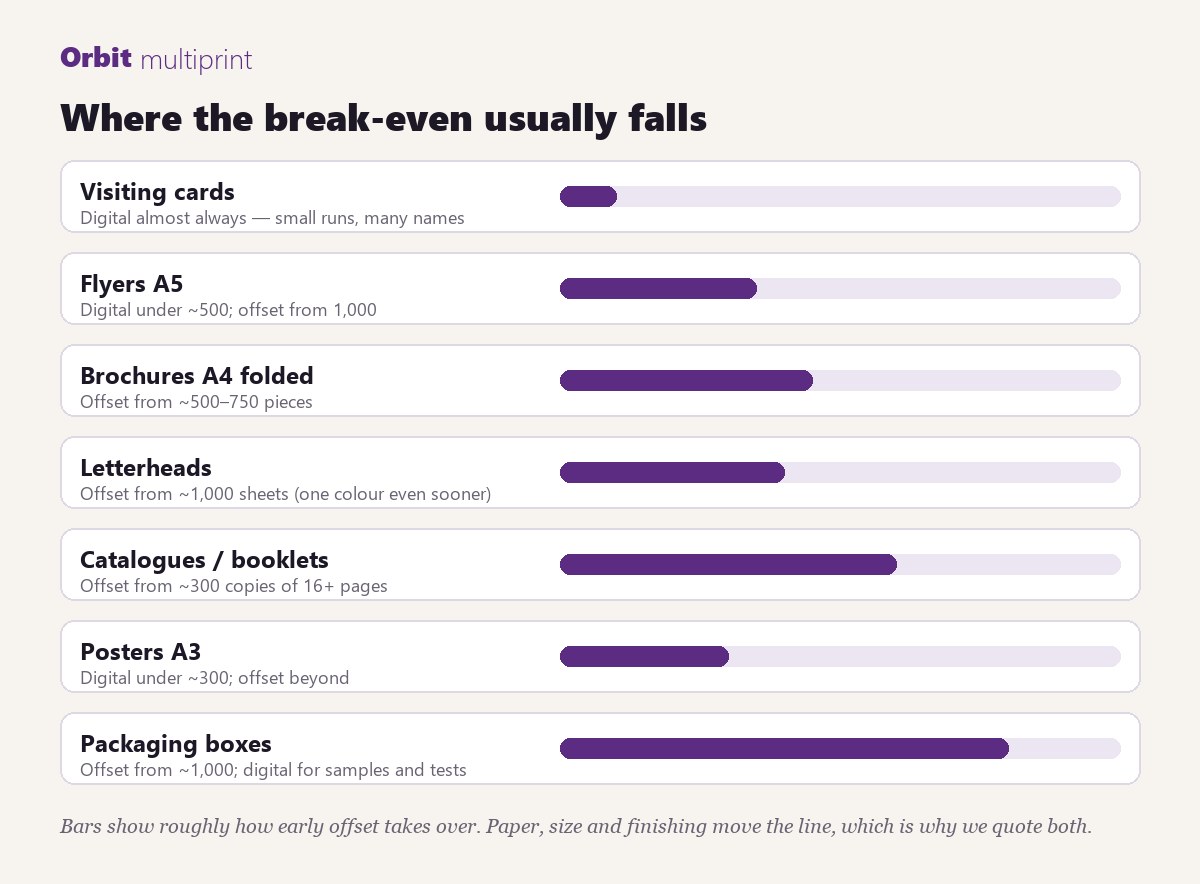
These are starting points, not rules. Heavier paper, bigger sheet sizes and lamination all shift the line. That is why our price calculator quotes both processes for every job above a hundred pieces and shows you the difference on your exact specification.
When the cheaper process is still the wrong choice
You need an exact brand colour. Offset can print Pantone spot inks and metallics. Digital simulates them in CMYK, usually very closely, but a navy or an orange that must match your signage is safer on offset.
You need it tomorrow. Digital can run the same day. Offset needs plates, press time, drying and finishing, so count two to five working days even when the quantity says offset is cheaper.
Every copy is different. Named certificates, numbered coupons, dealer-specific flyers: digital prints variable data at no extra cost. Offset would need a plate change for every version.
The paper is unusual. Very heavy board, deeply textured stock or metallic paper runs reliably on offset. Some of it will not pass through a digital press at all.
You will reorder soon. If a flyer will be reprinted every month, offset plates are reusable only if nothing changes. Price changes, new phone numbers and seasonal offers favour digital even at higher quantities.
What we do on a typical job
When an order comes in we check the quantity, the paper and the finishing on the job card, then route the job to the press that makes sense. A 300-copy brochure with matt lamination goes digital. A 2,000-copy version of the same brochure goes offset. If a job sits close to the line we tell you both prices and the trade-offs before printing, not after.
Both processes end up on the same finishing table. Lamination, creasing, folding, UV and cutting are identical, and each one is a step ticked on the job card so nothing is skipped.
Quick decision guide
1. Under 300 pieces, or needed within two days: digital. 2. Over 1,000 pieces of the same artwork: offset. 3. Between 300 and 1,000: price both. The paper and the finishing decide. 4. Exact spot colour or metallic ink: offset, regardless of quantity. 5. Variable names or numbers: digital, regardless of quantity.
Put your job into the price calculator or send the details on WhatsApp to +91 90165 28799 and we will tell you which press it should run on, with the price for each, before you decide. Browse brochures and flyers or visiting cards to start from a ready specification.